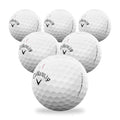


Every golfer asks it eventually: is a pre-owned golf ball really as good as a new one? The honest answer depends on the grade, so here is what actually changes when a ball has been played, and what you get at each grade.
What a round does to a golf ball
A golf ball's core and mantle set its compression and most of its flight, and a round of golf doesn't wear them out. What a round changes is the cover: it picks up scuffs from cart paths, bunker sand and trees, and the logo can fade. Light wear like that costs very little in flight.
The damage that does matter is a cut, a crack or a deep gouge. Those balls are pulled during inspection and never make either of our grades.
What you get at each grade
Grade A (Mint) is lightly played and looks close to new: no visible scuffs or discoloration, at most a faint player marking. It is never refinished, so every Grade A ball is exactly as the maker built it, and it plays like new.
Grade B (Near Mint) has visible cosmetic wear, such as a light scuff, some dulling or a previous owner's dot. It plays close to new. A Grade B dozen may also include the occasional refurbished ball, which won't play exactly like the original. That, and the cosmetics, is why Grade B costs less.
Can you tell the difference?
Looking at it, Grade A is hard to tell from a new ball, and Grade B you can see. In play, Grade A plays like new and Grade B plays close to it. If you want every ball to look and play as new, buy Grade A. If the ball is going into play rather than a display case, Grade B is the better value.
What it costs
Take the Titleist Pro V1. As of October 2026, a new dozen retails at $57.99, about $4.83 a ball. Our pre-owned Pro V1 is $33.99 a dozen in Grade A ($2.83 a ball) and $25.99 in Grade B ($2.17 a ball). Check the product page for today's price.
Try a dozen
Orders ship the next business day, shipping is free on orders over $99, and you have 30 days to return unused balls. The grading guide sets out exactly what each grade means.

